
South Carolina’s Comparative Negligence Rule

After a car accident, one of the first questions an insurance adjuster will ask is some version of, “what were you doing right before the crash?” It sounds like small talk. It is not. The answer can directly affect how much money you recover, or whether you recover anything at all, under South Carolina’s comparative negligence rule.
If you have been told you were “partly at fault” for an accident, here is what that actually means for your claim.
South Carolina Uses Modified Comparative Negligence
South Carolina follows a modified comparative negligence rule adopted by the South Carolina Supreme Court in Nelson v. Concrete Supply Co. The General Assembly's apportionment statute, S.C. Code § 15-38-15, also governs allocation of fault in cases involving multiple defendants. The rule is often called the “51% bar rule”:
If you are 50% or less at fault, you can still recover damages, reduced by your percentage of fault.
If you are 51% or more at fault, you recover nothing.
That single dividing line, 50% versus 51%, is why fault percentages get argued so aggressively in settlement negotiations and at trial.
How the Math Actually Works
The jury, or the insurance adjuster during negotiations, assigns a fault percentage to everyone involved. Your total damages are then reduced by your own percentage of fault. A few examples make this concrete:
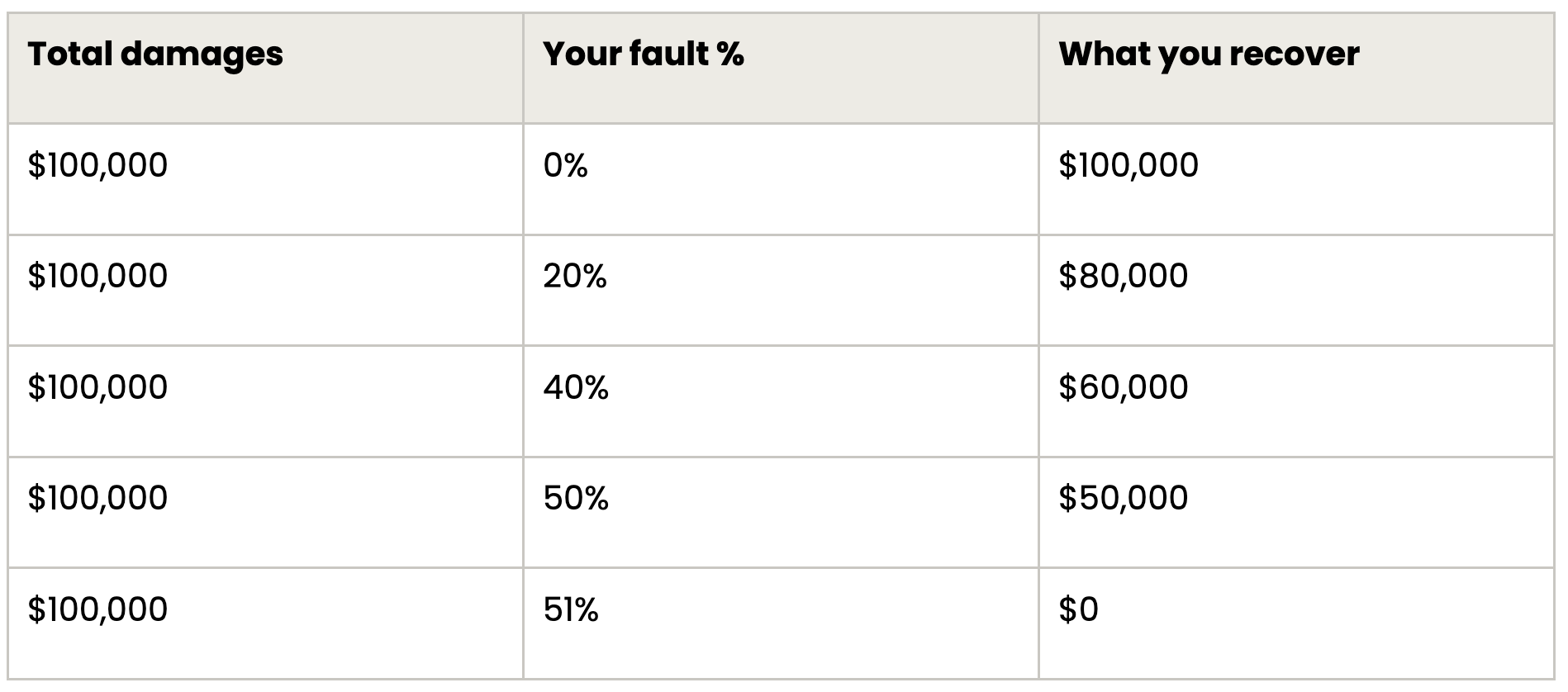
Notice how much is riding on that last row. The difference between 50% and 51% fault is the difference between a $50,000 recovery and nothing.
Why Insurance Companies Push Fault Percentages So Hard
Comparative negligence gives insurers a direct financial incentive to shift blame onto you, even partially. Attributing 25% fault to an injured person reduces the insurer’s payout by 25%, and attributing 51% eliminates it entirely. This is why adjusters ask pointed questions early, before you have had a chance to review the police report, get medical treatment, or speak with an attorney.
Common tactics include suggesting you were speeding, distracted, or slow to react.
Recorded statements taken soon after a crash are often used later to argue a higher fault percentage.
Partial fault does not mean no claim. It means a reduced claim, and the exact reduction is often negotiable with the right evidence.
What Counts as Evidence of Fault
Police accident report and officer narrative
Photos and video from the scene, dashcams, and nearby traffic or business cameras
Witness statements
Vehicle damage patterns and any available data from the vehicle’s event data recorder
Cell phone records, where distracted driving is at issue
Don’t Miss the Filing Deadline
South Carolina generally gives an injured person three years from the date of an accident to file a personal injury lawsuit under S.C. Code § 15-3-530, although exceptions and shorter deadlines may apply in certain cases. Waiting too long to pursue a claim, even one complicated by shared fault, can bar recovery entirely regardless of how strong the case is.
Frequently Asked Questions
If I was ticketed at the scene, does that mean I am automatically more than 50% at fault?
No. A traffic citation is a factor an adjuster or jury may consider, but it does not by itself set the legal fault percentage in a civil claim. Fault in a personal injury case is determined separately, based on the full evidence.
Can comparative negligence apply even if I was in a parked car?
Rarely, but it is possible if there is evidence the parked vehicle was placed or maintained in a way that contributed to the crash. Most parked-car claims involve little to no fault on the part of the parked driver.
Should I accept an early settlement offer that assumes I was partly at fault?
Be cautious. Early offers are often calculated using a fault percentage the insurer has not fully justified. Once you accept and sign a release, you typically cannot come back for more, even if new information later shows you were less at fault than the insurer claimed.
The Bottom Line
Being partially at fault for an accident in South Carolina does not end your case. It changes the math. The real question is not whether you contributed at all, but whether the evidence supports a fault percentage low enough to preserve a meaningful recovery, ideally well under that 51% line.
If an insurance company has told you that you were at fault for an accident in the Summerville area, Stegall Law can review the police report, evaluate the evidence, and push back on a fault percentage that does not hold up.
Learn more about Stegall Law’s personal injury representation in Summerville and throughout Berkeley, Charleston, and Dorchester counties.