
Power of Attorney vs. Healthcare Power of Attorney in South Carolina:
What’s the Difference?

When people think about estate planning, they often focus on what happens after they die. But some of the most important estate planning documents protect you while you're still alive.
Imagine you're hospitalized after an unexpected accident. Your spouse wants to speak with your doctors about your treatment, while your adult child needs to pay your mortgage, manage your bank accounts, or sign important paperwork on your behalf. Who has the legal authority to do those things?
Many people assume a single "power of attorney" covers every situation. In South Carolina, it doesn't. A Durable Power of Attorney and a Healthcare Power of Attorney serve different purposes, and most adults should have both.
What is the Difference?
Both documents allow you to appoint someone you trust—called your agent—to act on your behalf if you're unable to handle certain matters yourself.
The difference is what decisions your agent can make.
A Durable Power of Attorney gives your agent authority over financial and legal matters, while a Healthcare Power of Attorney authorizes your agent to make medical decisions if you're unable to communicate or make those decisions yourself.
These are two separate legal documents. One does not replace the other. You may choose the same person to serve in both roles, or you may appoint different people depending on who is best suited for each responsibility.
Durable Power of Attorney vs. Healthcare Power of Attorney
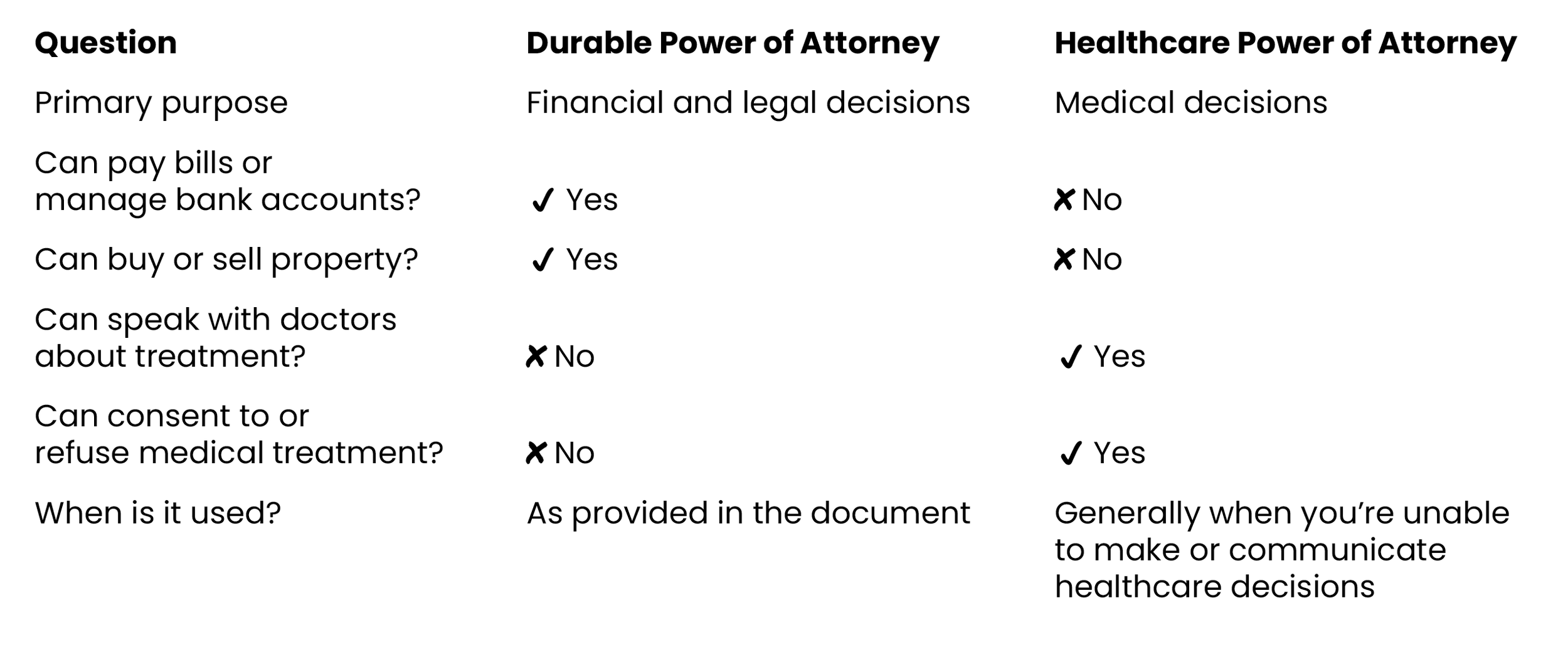
What Does a Durable Power of Attorney Do?
South Carolina has adopted the Uniform Power of Attorney Act, which governs Durable Powers of Attorney. A properly drafted document allows your chosen agent to handle financial and legal matters on your behalf.
Depending on the powers you grant, your agent may be able to:
Pay bills and everyday expenses
Access bank and investment accounts
Handle insurance matters
Buy, sell, or manage real estate
Sign contracts and legal documents
Deal with government agencies
Manage business interests
South Carolina law generally provides that a power of attorney is durable unless the document specifically states otherwise. This means your agent's authority continues even if you later become incapacitated.
To be valid, a POA must be signed, attested with the same witness formalities as a South Carolina will, and acknowledged or proved as required by § 30-5-30.
What Does a Healthcare Power of Attorney Do?
A Healthcare Power of Attorney is a separate document governed by South Carolina law.
Instead of financial matters, this document allows your chosen agent to make healthcare decisions if you cannot make or communicate those decisions yourself.
Your healthcare agent may be authorized to:
Speak with doctors and other healthcare providers
Consent to or refuse medical treatment
Review medical records as permitted by law
Make decisions regarding surgery or hospitalization
Carry out your wishes concerning your medical care
South Carolina law also limits who may serve as a witness or agent in certain situations, particularly if the individual is involved in your medical care or employed by your healthcare facility.
What Happens If You Don’t Have These Documents?
This is where many families run into unnecessary stress.
If you become incapacitated without a Durable Power of Attorney, your loved ones may have to ask the probate court to appoint a conservator to manage your financial affairs.
Without a Healthcare Power of Attorney, important medical decisions may become more complicated. Family members may disagree about your treatment, and healthcare providers may not know who should make decisions on your behalf.
Creating these documents ahead of time allows you—not a judge—to choose who will make those decisions.
Can My Spouse Automatically Make Decisions for Me?
This is one of the biggest misconceptions in estate planning.
Many people assume their spouse automatically has authority to handle financial matters or make medical decisions during an emergency.
Not necessarily.
Marriage alone does not automatically give one spouse legal authority to manage the other's finances or make every healthcare decision. Properly prepared estate planning documents help ensure your chosen decision-maker has the authority needed when it matters most.
Choosing the Right Agent
Selecting your agent is just as important as signing the documents.
Choose someone who is:
Honest and trustworthy
Financially responsible
Organized and dependable
Comfortable making difficult decisions
Willing to carry out your wishes—even under pressure
For many families, the person best suited to handle finances is not the same person best suited to make healthcare decisions. South Carolina law allows you to appoint different agents for each role if that makes the most sense for your family.
Frequently Asked Questions
Does my spouse automatically have power of attorney?
No. Marriage alone does not automatically give one spouse authority to manage the other's financial affairs or make all healthcare decisions. Proper legal documents are still important.
Can I name more than one agent?
Yes. South Carolina law allows you to appoint co-agents or successor agents. In many cases, naming one primary agent with one or more backups helps avoid disagreements while ensuring someone is available if your first choice cannot serve.
Can I change my power of attorney?
Yes. As long as you have legal capacity, you may revoke or replace your Durable Power of Attorney or Healthcare Power of Attorney at any time.
Does a power of attorney continue after I die?
No. A power of attorney ends immediately upon the principal's death. After that, the person named as executor or personal representative under your will—or appointed by the probate court—takes over responsibility for administering your estate.
The Bottom Line
Estate planning isn't just about deciding who receives your property after you pass away. It's also about protecting yourself and your family during your lifetime.
A Durable Power of Attorney and a Healthcare Power of Attorney work together to ensure that the people you trust can step in when you need them most. Having both documents in place can help avoid confusion, reduce the need for court involvement, and provide peace of mind for you and your loved ones.
If you're creating an estate plan for the first time or updating older documents, Stegall Law can help you prepare Durable Powers of Attorney, Healthcare Powers of Attorney, wills, and other estate planning documents tailored to your wishes and compliant with South Carolina law.
Learn more about Stegall Law’s powers of attorney and estate planning services in Summerville and throughout Berkeley, Charleston, and Dorchester counties.